
Hull Rupture Galaxy Map: Routes and Star Types
How Hull Rupture's galaxy map works: star types, fog of war, travel speed, guarded nodes, and how to choose a route that fits your ship.
The galaxy map is where Hull Rupture stops being a single ship and becomes a campaign. Each star offers a choice: an event, a market, a guarded fight, a shipyard, or a modifier that changes the rest of the run. You cannot visit everything, and the route you skip is as important as the route you take.
The map is not a menu. Travel takes time, fuel, and engine capacity, and every detour is a wave you are not spending on production. A rich node on the far side of the map can be the best decision in the run or the reason the ship arrives at the boss with no repair reserve.
"Choosing where to fly (and knowing what your ship needs when you make that choice) can make the difference between a thriving war machine and a very expensive drifting coffin."
— Official source: Hull Rupture Devlog #3: Galaxy Exploration
For the rewards a route can produce, see modifiers; for spending between nodes, see shop.
Their extra waves sit on top of the Classic 20. Take one when the reward fits the build, not because the node is on the shortest path.
How the galaxy map works
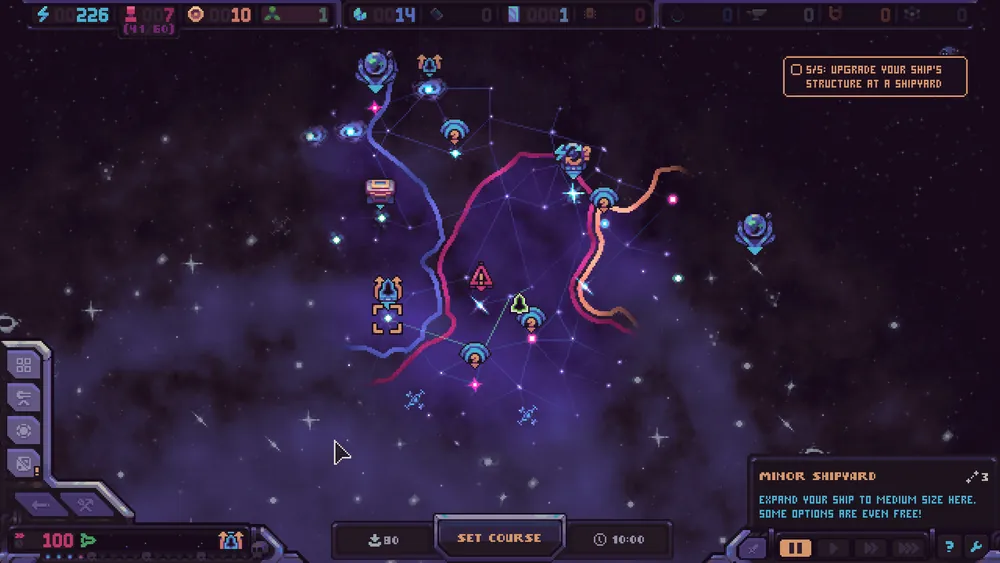
The map gives you short-term goals between battles. Every star is visible, but its type is hidden until you explore it. Fog of war covers parts of the map, and exploring reveals the types of nearby stars without revealing the exact event.
The campaign frame is simple: decode the Galactic Union network, keep the ship moving toward the alien homeworld, and survive the fleets sent to stop you. The map is the space between those fights.
Three resources govern map movement:
- Fuel. Engines consume it. A shortage slows the ship rather than stopping it.
- Engines. More engines and higher engine levels increase speed, but engines need workers.
- Mass. More modules and hull make the ship heavier and slower.
That makes the map a second economy. A compact ship visits more nodes; a heavy ship fights more waves on the road. Neither is automatically better, but the choice should be deliberate.
Star types
Konfa has confirmed around 15 star types, each with a different opportunity. The exact list is not public, but the confirmed categories are enough to plan around.
| Star type | What it offers | Risk |
|---|---|---|
| Random event | Modifiers, resources, narrative choices | Unpredictable outcome |
| Black Market | Modifiers and goods for sale | Costs resources you may need |
| Guarded location | High-value reward | Extra waves; higher difficulty only |
| Shipyard | Ship upgrades and construction options | Cost and travel time |
| Resource node | Fuel, minerals, or advanced materials | Usually low risk |
| Boss node | Major fight | High damage, boss landing |
| Wormhole | Long-distance travel | Planned feature; not confirmed for launch |
The most important distinction is between known and unknown value. A Black Market tells you what it sells; a random-event star does not. A guarded location tells you there will be a fight; a resource node usually does not.
Random-event stars are the main source of modifiers. That makes them the highest-variance nodes: a great event can define a build, and a bad one can kill a module or a chunk of the population.
Fog of war and information
You see every star, but not every type. Fog of war hides parts of the map until you explore, and even revealed stars do not show the exact event.
That creates a scouting decision. Do you spend fuel to reveal a cluster of stars, or do you take the known route and save the fuel for the boss? The answer depends on the ship's current bottlenecks:
- If the economy is stable, explore. Modifiers and rare resources are the best long-term investment.
- If the ship is fragile, take the safe route. A bad event at low population can end the run.
- If the next wave is a boss, do not detour. Arrive with a repair reserve.
Information is a resource, but it is not free. The map's fog is designed to make you commit before you know everything.
Travel speed and mass
Travel speed is the most underrated stat in the game. It determines how many nodes you can visit, how many events you can take, and how many waves you fight between objectives.
The formula is qualitative but consistent:
- More engines means faster travel.
- Higher engine levels means faster travel.
- More modules and hull means slower travel.
- More humans in engines means faster travel, at the cost of production staffing.
A low-mass ship with a few upgraded engines can visit many nodes. A heavy ship with a large factory can produce more per wave but reaches fewer opportunities. The full game's three ships are designed around this tradeoff; one of them specifically supports the low-mass, many-destination playstyle.
Do not add hull just because you have resources. Every block is mass, and mass is time. If the new section does not produce something or shorten a defensive route, it is probably a net loss for the map.
Route planning by phase
Early game: take nearby resource nodes and one random event. Avoid guarded locations until the airlock has a turret and a repair path.
Mid game: target Black Markets and shipyards. This is where modifiers and engine upgrades compound. If the population is healthy, take a guarded location for a rare reward.
Late game: plan the last three nodes around the boss. A repair node, a market for a final turret, or a safe route with no extra waves can be better than a high-value detour.
The map is generated with rules and patterns, and experienced players learn to recognize them. You will not predict every event, but you will learn which shapes of route tend to be profitable.
Events and sacrifices
Narrative events are the map's best storytelling and its biggest trap. They can demand resources, humans, or a module, and the "good" option is often the expensive one.
The preview's example was a sacrifice option requiring 20 humans. If the workforce was below 20, the option was unavailable. That is a hidden cost of population loss: you do not just lose workers, you lose choices.
Before accepting an event, check:
- Can the ship survive the cost? A 20-human sacrifice is fine at 40 population and fatal at 22.
- Does the reward fit the build? A modifier for a module you do not use is a wasted event.
- Is the alternative worse? Some events punish refusal with a curse or a fight.
Events are also a source of free modules, artifacts, and resources. The best route is not always the safest; it is the one that gives the ship something it cannot buy.
Guarded locations and extra waves
Guarded locations are high-value nodes that trigger extra waves. Those waves do not count toward the Classic 20, which means they are pure additional risk.
Konfa has said guarded locations are planned for the full release at higher difficulties. That makes them a difficulty-scaling feature, not a default route. On lower difficulties, the map may not offer them at all.
If you take a guarded node, do it after a wave, with a full repair reserve and a turret line that covers the landing zone. Do not take one on the way to a boss.
Sources and further reading
Related
- How event rewards change a run
- When to spend tokens between nodes
- Why guarded nodes matter more on high difficulty
FAQ
How many star types are there? Around 15. The exact list is not public, and not every type appears in every run.
Can I visit every node? No. The map is designed so that a single run cannot cover everything.
What happens if I run out of fuel? The ship still moves, but slowly. That costs time and forces extra waves.
Are wormholes in the launch build? Wormholes were described as a planned feature, compared to the teleporters in Heroes of Might and Magic. They are not confirmed for launch.
Do guarded nodes count toward the 20 waves? No. Extra waves from guarded locations do not count toward the Classic 20.
More Hull Rupture Guides
Hull Rupture treats humans as a resource. Learn where to assign them, when to convert them in the Bioreactor, and how to avoid a population death spiral.
How Hull Rupture modifiers and artifacts work: shop vs event pools, confirmed effects, conditional bonuses, and which builds are worth committing to.
Hull Rupture module guide: confirmed production rooms, adjacency bonuses, module kits, selling duplicates, and placement rules for a stable ship.
Hull Rupture launches on PC, Mac, and Linux on November 4, 2026. There is no PS5, Xbox, Switch, or mobile version. Here is the full platform status.
How Hull Rupture's energy economy works: generator staffing, module upkeep, brownout recovery, and when to stop building before the ship stalls.
Hull Rupture has no full reviews yet. Here is what the April preview build praised, what it criticized, and how the demo's reception frames the launch.
Hull Rupture releases November 4, 2026 on PC, Mac, and Linux. Here is what Steam has confirmed about the price, launch time, demo, and day-one content.
How repair works in Hull Rupture: breach priority, energy costs, repair module placement, and when to abandon a damaged section instead of rebuilding it.